
If your dog inhales a full bowl of food in under a minute, you are not alone — and you are right to wonder whether it is a problem. Fast eating is one of the most common mealtime habits owners ask about, and the good news is that it is usually easy to improve with a few small changes.
Why do dogs eat so fast?
Dogs are natural scavengers. In a litter or a pack, food does not wait around, so eating quickly is an instinct rather than bad manners. Some dogs gulp because they once competed for food, some because they simply love to eat, and some because one large bowl a day leaves them very hungry by mealtime. Whatever the reason, the behaviour is normal — it is the speed we want to gently slow down.
Why eating too fast matters
When a dog gulps, it swallows a lot of air along with the food. That can lead to burping, gas, and an uncomfortable, bloated belly soon after eating, and fast eaters are more likely to vomit a meal back up within minutes. In deep-chested breeds, very fast eating is one of several factors associated with a serious condition called bloat (gastric dilatation-volvulus), so slowing the pace is a sensible, low-effort habit. If your dog ever has a swollen, hard abdomen, retches without bringing anything up, or seems distressed after eating, treat it as an emergency and call your vet right away.
Gentle ways to slow your dog down
- Split the day into smaller meals. Two or three smaller portions are easier to eat calmly than one big bowl.
- Use a slow feeder. A maze bowl or a slow-feeder toy makes your dog work around obstacles, stretching a 30-second meal into several minutes.
- Turn dinner into a puzzle. A treat-dispensing puzzle feeder makes your dog nudge and paw for each piece, which naturally paces the meal and adds a little brain work.
- Scatter or hand-feed. Tossing kibble across a clean floor or a snuffle mat lets your dog forage piece by piece.
- Add a little water. Moistening dry food can make a gulped meal sit more comfortably.
Where a duck-shaped slow feeder fits in
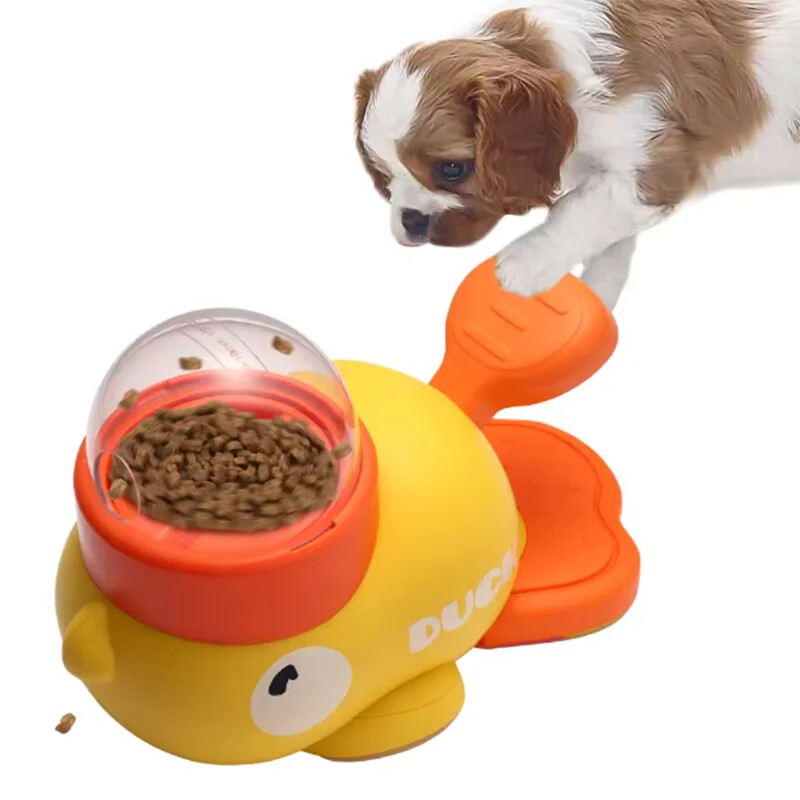
One of the easiest swaps is a slow feeder that doubles as enrichment. Duckpawl is a duck-shaped treat dispenser and slow feeder: you fill the clear dome with dry kibble, and your dog presses the duck’s tail with a paw to release a few pieces at a time. Because the food comes out gradually, a frantic gulp becomes a calm few minutes — and because your dog has to solve it, mealtime turns into a small game rather than a race. It needs no batteries, works for dogs and cats, and has an anti-slip base so it stays put.
How slow is slow enough?
There is no magic number, but a good target is turning a sub-minute meal into three to five minutes of steady eating. Watch your dog the first few times with any new feeder, start on an easy setting so they do not get frustrated, and always supervise play. If you are also tackling boredom between meals, our guide to dog enrichment and brain games has plenty more ideas.
Frequently asked questions
Do slow feeders really work? Yes — by adding physical obstacles or a dispensing mechanism, they make it harder to inhale a whole meal, which naturally slows the pace.
Are slow feeders safe for puppies? Generally yes, with supervision and an easy starting level so a young puppy does not get discouraged. Check with your vet if your puppy is very small.
My dog still eats fast even with a slow feeder — what now? Try smaller portions, a more challenging feeder, or splitting the meal across two feeders. Persistent gulping or any sign of distress is worth a vet visit.
Ready to make mealtime calmer? Meet Duckpawl.