
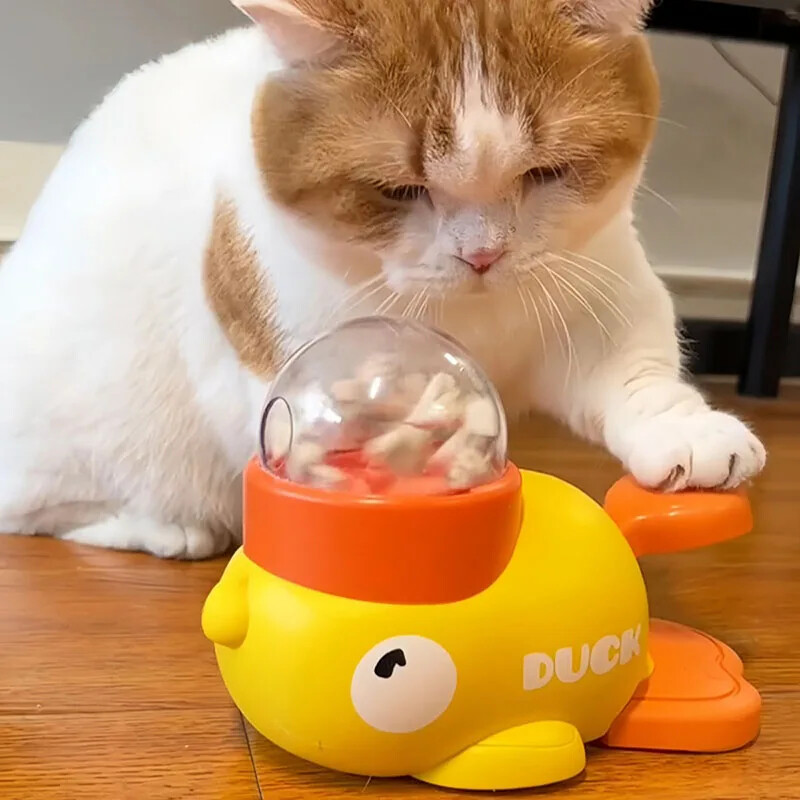
The working answer is one puzzle feeder per cat as a minimum, plus a spare or two of whichever design proves most popular. Cats do not queue politely, and a single feeder shared between two or three of them turns mealtime into a competition rather than an activity. The extras matter because preference is not evenly distributed: if all your cats favour the same style, having only one of it recreates exactly the bottleneck you were trying to avoid.
Spacing matters as much as the number. Feeders lined up beside each other are functionally one feeding station, and a nervous cat will not use the middle one regardless of how many you own.
Why one per cat is the baseline
Cats are not naturally group feeders. Even cats who get along well and share a home comfortably tend to prefer eating alone, and a shared resource introduces a decision — approach and risk an encounter, or wait. Confident cats approach. Less confident ones wait, and often simply stop eating that meal.
Puzzle feeders sharpen this, because they take longer. A bowl is emptied in ninety seconds and the moment of overlap is brief. A puzzle occupies the space for ten or fifteen minutes, which is plenty of time for a standoff to develop. Giving each cat their own removes the decision entirely.
The review of food puzzles for cats published in the veterinary literature makes the same recommendation, and adds a useful refinement: where one type of puzzle is clearly preferred, provide several of that type rather than a variety, so no cat is forced onto a design they dislike.
What the evidence actually shows
The reassuring finding is that this generally works. In shelter settings, where cats live in groups without the luxury of choosing their housemates, around 85 percent of group-housed cats engaged with food puzzles without any increase in aggression between them.
That is worth knowing if you have been avoiding puzzle feeders on the assumption they would cause fights. Provided there are enough of them and they are sensibly spaced, food puzzles are not usually a flashpoint. The problems arise from scarcity and proximity, not from the puzzles themselves.
For introducing the feeders themselves once you have enough of them, the BC SPCA’s five tips are a sensible starting point, and apply per cat rather than per household.
Spacing, sightlines and escape routes
Three things decide whether your cats can eat calmly in the same house.
- Distance. Further apart than feels necessary. Different rooms if you can manage it; opposite ends of a large room at minimum. Two feeders a metre apart are one station as far as your cats are concerned.
- Sightlines. A cat who can see another cat approaching while they are mid-puzzle is not relaxed. Corners, furniture and doorways all help break the line of sight.
- Escape routes. No cat should be eating in a dead end. If the only way out of the feeding spot is past another cat, the timid one will avoid it entirely.
Vertical space is genuinely useful in small homes. Cats are content to eat at different heights, and putting one feeder on a low shelf or a sturdy cat tree creates real separation in a room that has no space for horizontal distance. Only do this with cats who jump comfortably — for older or heavier cats, keep everything at floor level.
When one cat dominates
Some households have a cat who works through their own feeder and then goes looking for everyone else’s. This is common and does not usually mean the cats dislike each other.
The straightforward fixes, roughly in order of how much effort they take:
- Stagger difficulty. Give the fast cat a harder puzzle and the slower one something easier, so they finish closer together.
- Stagger timing. Set the slower cat up a few minutes earlier, so they have a head start rather than a shared start.
- Separate rooms with the door shut for the duration of the meal. Unglamorous, entirely effective, and usually needed only until a routine settles.
- Microchip feeders for persistent cases, particularly where one cat is on a prescription diet.
What does not work is expecting the cats to sort it out. Cats do not negotiate over resources; the confident one takes and the other adapts by eating less.
Different cats, different difficulty
Buying identical feeders for every cat is tidy but often wrong. Cats within a household frequently differ in age, mobility and confidence far more than their owners expect.
An older or arthritic cat needs something stationary and shallow, while a young one may be bored by exactly that. A cat who has never used a puzzle needs to start far easier than one who has been doing it for a year. Match each cat rather than the household, and expect to adjust as they age.
Our guide to puzzle feeders for senior cats goes into the mobility side, which is usually the constraint that matters first.
Kittens and adults together
Mixed-age households need a bit more thought. Kittens take to puzzles quickly and enthusiastically, which is good, but they also eat more often and are considerably less inhibited about helping themselves to an adult’s feeder.
The practical approach is to feed the kitten more frequently rather than more at once, and to keep those extra meals physically separate from the adults’ feeding areas. A kitten who learns early that other cats’ food is fair game will carry that habit into adulthood, and it is much harder to undo later than to avoid now.
Difficulty should differ too. Kittens can handle more challenge than most people give them, while an adult cat new to puzzles usually needs to start easy. Assuming the adult is more capable simply because they are bigger is a common mistake.
The logistics nobody warns you about
Four feeders is four times the washing up, and this is the practical reason multi-cat puzzle feeding often quietly stops after a month.
Two things make it sustainable. Choose designs that can be rinsed rather than dismantled, at least for daily meals, and keep the elaborate multi-part puzzles for occasional use. And buy two sets if budget allows, so one can be drying while the other is in use, which removes the moment where washing up stands between you and feeding the cats.
Rotating feeders between cats is also worth avoiding unless you wash them properly in between. Cats are sensitive to the scent of other cats on their things, and a feeder that smells strongly of a housemate is one some cats will decline to use at all.
Knowing who ate what
This is the practical difficulty of multi-cat puzzle feeding, and it matters more than it sounds. Once food is distributed across several devices in several rooms, it becomes genuinely hard to know whether a particular cat has eaten.
That is a problem because a cat going off their food is an important early sign of illness, and it is exactly the signal you lose. Two habits help. Supervise at least one meal a day rather than distributing and leaving. And measure each cat’s daily allowance separately in the morning, so an untouched portion is obvious at the end of the day rather than lost in the total.
If one of your cats is on a prescription or weight-management diet, supervision stops being optional. Food left in a puzzle is available to whoever finds it, and the cat whose intake matters most is often the most motivated to go looking.
One last point on numbers: the same logic applies to every other resource in the house. If you are adding feeders for the sake of reducing competition, it is worth counting litter trays, water bowls and resting spots at the same time. The usual guidance is one per cat plus one spare, and a household that gets feeding right while leaving two cats sharing a single tray has only moved the pressure somewhere less visible.
When to talk to your vet
Please speak to your vet if one of your cats stops eating or noticeably reduces what they eat, if a cat starts guarding food or becoming aggressive around it when they did not before, or if any cat is losing weight.
Sudden changes in feeding behaviour are worth taking seriously in cats. A cat who begins guarding resources may be in pain or feeling unwell, and a cat quietly eating less in a multi-cat home can go unnoticed for weeks. We are not veterinarians, and nothing here is medical advice.
For the broader case for feeding cats this way, see our guide to puzzle feeding for indoor cats, or browse the guides section.
Common questions
How many puzzle feeders do I need for two cats?
At least two, and ideally three so neither cat is forced onto a design they dislike. Place them well apart rather than side by side.
Will puzzle feeders cause fighting between my cats?
Usually not. In shelter research around 85 percent of group-housed cats used food puzzles without increased aggression, provided there were enough of them and they were spaced apart.
One cat finishes first and steals from the others. What helps?
Give the fast cat a harder puzzle, start the slower cat a few minutes earlier, or simply feed them in separate rooms with the door shut.
Can I use puzzle feeders if one cat is on a prescription diet?
Only with supervision or a microchip feeder. Food left in an open puzzle is available to any cat who finds it.