
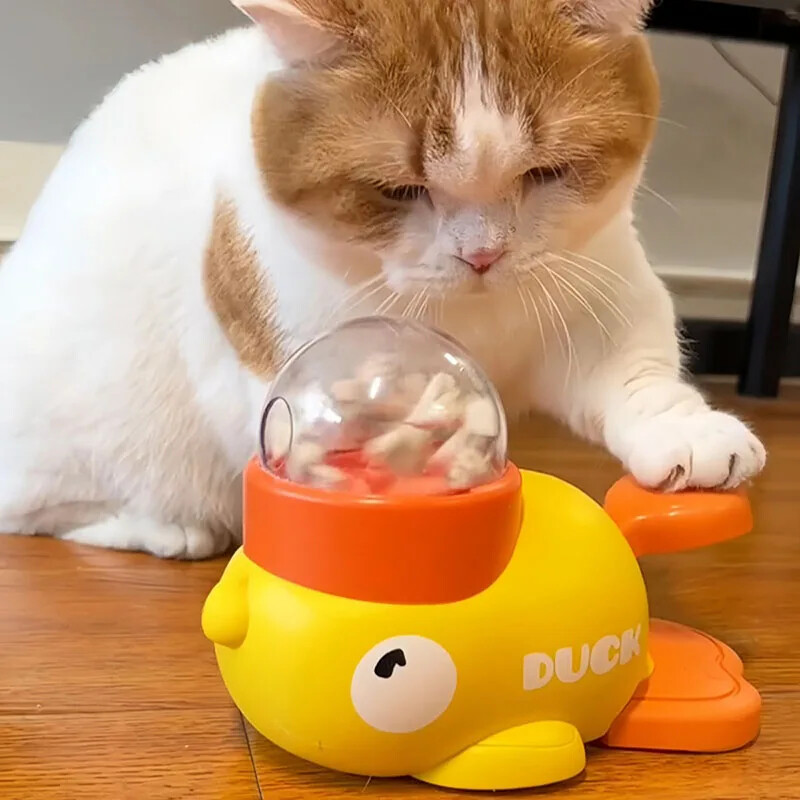
Senior cats benefit from puzzle feeding as much as younger ones, and often need it more, because the boredom of a quiet indoor old age is real. What changes with age is the difficulty they can comfortably manage. An older cat with stiff joints will not chase a rolling feeder around a room, and will not reach deep into a narrow well. Get the design right and puzzle feeding stays worthwhile well into old age. Get it wrong and your cat quietly stops bothering, which is easy to mistake for disinterest.
The useful mental shift is to stop thinking about how much of a challenge the feeder provides, and start thinking about how much effort it costs. Those are different questions, and for a senior cat the second one is the important one.
Do older cats still get anything out of it?
Yes, and the benefits are broadly the same as for a younger cat: slower eating, some light activity, and mental occupation in a day that otherwise contains very little. International Cat Care notes that puzzle feeders suit cats across a wide range of ages and abilities, not only the young and agile.
There is a specific argument for older cats too. Cognitive decline in senior cats is real, and regular low-level problem solving is one of the few things routinely suggested to help occupy an ageing mind. A feeder that asks a small question twice a day is a modest but genuine intervention.
Mobility comes first
Arthritis is extremely common in older cats and often goes unnoticed, because cats do not limp in the obvious way dogs do. They simply do less: fewer jumps, shorter play, more time in one spot.
Applied to feeders, that means anything requiring sustained physical effort is likely to be abandoned rather than attempted. It also means the classic signs of a feeder being too hard — walking away, half-finished food, loss of interest — are more likely to be about comfort than about difficulty in the cognitive sense.
Vetster’s guide to enriching a senior cat’s day is a useful companion here, since feeding is only one part of keeping an older indoor cat occupied.
Stationary beats rolling
This is the single most useful design rule for a senior cat.
Rolling and wobbling feeders require the cat to move continuously, track a moving object, and stay balanced while doing it. For a young cat that is the appeal. For an arthritic one it is three separate difficulties layered on top of the food.
Stationary designs — boards with wells, mats, upright tubes with openings — let the cat settle in one position and work at their own pace. If your older cat has abandoned a feeder they used happily two years ago, moving from a rolling design to a stationary one is the first thing to try.
Shallow wells, wide openings
Reaching into a deep narrow well means extending a leg and rotating a shoulder, which is exactly the movement a stiff cat avoids. Look for wells they can reach into with a paw held fairly flat, and openings wide enough that the whole action is casual rather than deliberate.
Many puzzles are adjustable, and the adjustment is usually free. Open every slider fully, remove any optional covers, and only increase difficulty if your cat is clearly finding it too easy. Starting at maximum difficulty and working down wastes your cat’s willingness, which for an older animal is in shorter supply.
Simple designs that ask for one repeated paw movement, rather than a sequence, tend to hold up best with age. Our Duckpawl treat dispenser works on a single tap action, which suits cats who can still use a paw comfortably but no longer want a complicated puzzle.
Height and placement
Where the feeder sits matters as much as what it is. An older cat should not have to jump to reach food. If the feeder currently lives on a counter or a windowsill because that is where the bowl always went, move it to the floor.
Equally, some senior cats are more comfortable with the feeder very slightly raised, so they are not crouching low. A few centimetres on a stable surface is enough. Watch which your cat prefers rather than assuming, and give them a non-slip surface underneath either way — an older cat managing their footing on tile is spending effort that should be going into the meal.
Water deserves a mention alongside food here. Older cats are prone to drinking too little, and a water bowl sitting right beside the feeder is often ignored, since many cats prefer their water away from where they eat. Moving it a couple of metres away frequently increases how much they drink, at no cost to you.
Wet food and softer options
Many older cats move onto wet food, sometimes for dental reasons, and most conventional puzzles assume kibble. There are still options.
Lick mats work well with wet food and ask almost nothing physically, which makes them a good fit for the stiffest days. Silicone trays with shallow depressions do a similar job. Both slow the meal considerably by making the cat work along a surface instead of eating from a pile, and both are far easier on joints than any maze.
A rotation is often better than a single choice. A stationary puzzle on good days, a lick mat on stiff ones, and the difficulty adjusted rather than fixed.
Keeping it interesting without making it harder
There is a tempting logic that says an older cat who has mastered a feeder needs a harder one. Usually they do not. What keeps a senior cat engaged is novelty rather than difficulty, and those can be separated.
Rotate between two or three feeders of similar difficulty rather than escalating one. Change where they are placed. Change what goes in them, within whatever your vet has advised. All of that renews interest without asking more of the joints.
If you do want to add challenge, add it to the search rather than the mechanism — putting the same easy feeder in a slightly less obvious spot asks the cat to find it, which costs a short walk rather than sustained paw work.
One more placement consideration that matters for older cats: keep the feeder away from the litter tray and away from wherever the household is noisiest. Senior cats are generally less tolerant of being interrupted, and a cat who feels exposed while working at a puzzle will abandon it faster than one who feels settled.
Corners and walls help here. A feeder positioned so the cat can eat with their back to something, and with a clear view of the room, tends to get used more consistently than one in the middle of a busy floor. This costs nothing to change and is worth trying before concluding a feeder is unsuitable.
Senses change too, not just joints
Mobility gets the attention, but older cats often lose some sight and a good deal of their sense of smell, and both affect feeding.
A cat who cannot smell the food as strongly may simply not realise the feeder has anything in it. Warming wet food slightly makes it far more obvious, and works well with lick mats. For a cat with failing sight, consistency of placement matters more than it used to — a feeder that lives in the same spot every day can be found by memory, while one that moves around the kitchen cannot.
Contrast helps as well. A pale feeder on a dark mat is easier to locate than one that blends into the floor, which is a small change that costs nothing.
A sudden drop in interest is a vet matter
This is the most important paragraph here. If a senior cat who has been using a feeder happily suddenly stops, do not assume the feeder has become boring.
Appetite changes in older cats are worth investigating. Dental disease, kidney problems, thyroid conditions and pain all show up as reduced interest in food, and a feeder is often where the change becomes visible first, because it is the point where eating requires a decision. Please speak to your vet if your cat’s interest in food drops noticeably, if they lose weight, if they start eating on one side of the mouth, or if they approach food and then walk away.
We are not veterinarians, and nothing here is a diagnosis. What we would say is that older cats are frequently described as fussy when they are actually uncomfortable, and the difference is worth establishing properly.
For the broader case for puzzle feeding indoor cats, see our guide to mental stimulation for indoor cats, or browse the guides section.
Common questions
Are puzzle feeders suitable for senior cats?
Yes, provided the difficulty matches their mobility. Stationary designs with shallow wells suit older cats far better than rolling or wobbling feeders.
My old cat stopped using a feeder he liked. Why?
Most often comfort rather than boredom. Stiff joints make reaching and chasing harder. Try a stationary, shallower design before giving up on the idea.
Can I use a puzzle feeder with wet food?
Yes. Lick mats and shallow silicone trays work well with wet food and ask very little physically, which suits cats with sore joints.
When should a change in feeding be checked by a vet?
Any noticeable drop in appetite, weight loss, chewing on one side, or approaching food and walking away. Appetite changes in older cats are worth investigating.