
Yes, a slow feeder can help an arthritic dog, but only if it is set up to work with the joints rather than against them. The bowl needs to sit high enough that your dog is not craning downward, the maze needs to be shallow and wide rather than deep and narrow, and the floor underneath needs to give some grip. Get those three things right and a slow feeder turns a rushed meal into a manageable one. Get them wrong and you have simply turned dinner into a workout for a dog who cannot really afford one.
That distinction matters more as dogs age. A younger dog will happily shove a bowl around the kitchen to get at the last few pieces. An older dog with sore hips or elbows will often just stop, walk away, and leave food behind, and it is easy to read that as fussiness or a fading appetite when it is really a dog telling you the puzzle costs more than the meal is worth.
Do slow feeders help arthritic dogs?
Usually, yes. The reason to slow a dog’s eating does not go away with age. Dogs who inhale a meal tend to swallow a lot of air with it, and the result is often discomfort, hiccuping, or bringing the food straight back up a few minutes later. Slowing the pace gives the dog a chance to chew and gives the stomach a chance to keep up. The American Kennel Club covers the general case for slowing a fast eater well.
What changes with arthritis is the cost side of the equation. A slow feeder deliberately makes food harder to reach. For a healthy dog that added effort is the point, and it is mild. For a dog with joint pain, the same effort is spread across a body that is already working harder than it used to, and it lands on exactly the parts under strain: the neck, the shoulders, the front legs bearing weight while the head is down.
So the goal shifts. You are not looking for the feeder that slows your dog the most. You are looking for the one that slows them enough while asking the least of the joints. Those are different products, and the second one is rarely the one marketed as most challenging.
Why bowl height matters more than the maze
If you change one thing, change the height. A dog eating from a bowl on the floor holds their head low and their neck extended for the length of the meal. Extend that meal from thirty seconds to ten minutes with a slow feeder and you have multiplied the time spent in that position by twenty.
Raising the bowl so the rim sits somewhere around your dog’s lower chest lets them eat with the neck closer to level. Most dogs settle into this quickly. You do not need a purpose-built stand to try it, and it is worth testing before buying anything: a sturdy box, a thick book under a non-slip mat, or an upturned crate will tell you within a couple of meals whether your dog is more comfortable.
Watch how they stand rather than how fast they eat. A dog who is comfortable will settle with weight fairly even across all four feet. A dog who is not will shift, brace a front leg, sit down partway through, or take breaks that have nothing to do with being full.
Choosing a maze pattern for stiff joints
Slow feeder bowls broadly fall into two families, and the difference matters here more than it does for a younger dog.
- Deep, narrow spirals and tight channels. These slow a dog down aggressively because the tongue has to work into confined spaces, which usually means repeated head tilting and pushing. Effective, and hard on a stiff neck.
- Wide, shallow ridges and open compartments. These slow a dog by spreading food across a larger area rather than by burying it. The dog moves along the bowl instead of digging into it.
For an arthritic dog, the second family is almost always the better starting point. It is also the easier one to adjust: if your dog is still eating too quickly, you can add a little water or switch to a larger kibble to slow things further, without making the bowl itself more punishing.
One practical check before you buy anything: look at the depth of the channels relative to your dog’s muzzle. A flat-faced dog and a long-nosed dog need quite different geometry, and a bowl that suits a spaniel can be genuinely unusable for a pug.
Floor surface and footing
This is the part most people skip, and it is often the cheapest fix available.
A dog eating on tile, laminate, or polished wood spends the whole meal managing their own footing. For a dog with weak hindquarters or sore elbows, that background effort can be more tiring than the puzzle in front of them. It also makes the bowl itself a moving target, because a lightweight feeder slides across a hard floor as soon as the dog pushes into it.
A rubber-backed mat, a yoga mat, or a bath mat under both the dog and the bowl solves both problems at once. The dog gets grip, the bowl stays put, and the meal stops being a balancing exercise. If your slow feeder has a suction base, a mat is still worth adding, because suction bases rely on a smooth surface and tend to release exactly when a dog leans into them hardest.
Low-effort alternatives when a bowl is too much
Some dogs reach a point where any bowl-based puzzle is too much on a bad day, and it is worth having gentler options ready rather than abandoning slow feeding entirely.
- Lick mats. Wet food or something soft spread across a textured mat slows eating through licking rather than manipulation. There is almost no joint load, and it can be used at floor level or raised.
- Scatter feeding on a towel. Spread kibble through the folds of a towel laid flat. The dog uses their nose more than their body, which is gentler than it looks and still takes real time.
- Splitting the meal. Two smaller portions twenty minutes apart slow the overall pace without asking anything additional of the dog at all. Preventive Vet covers this and several other approaches in more detail.
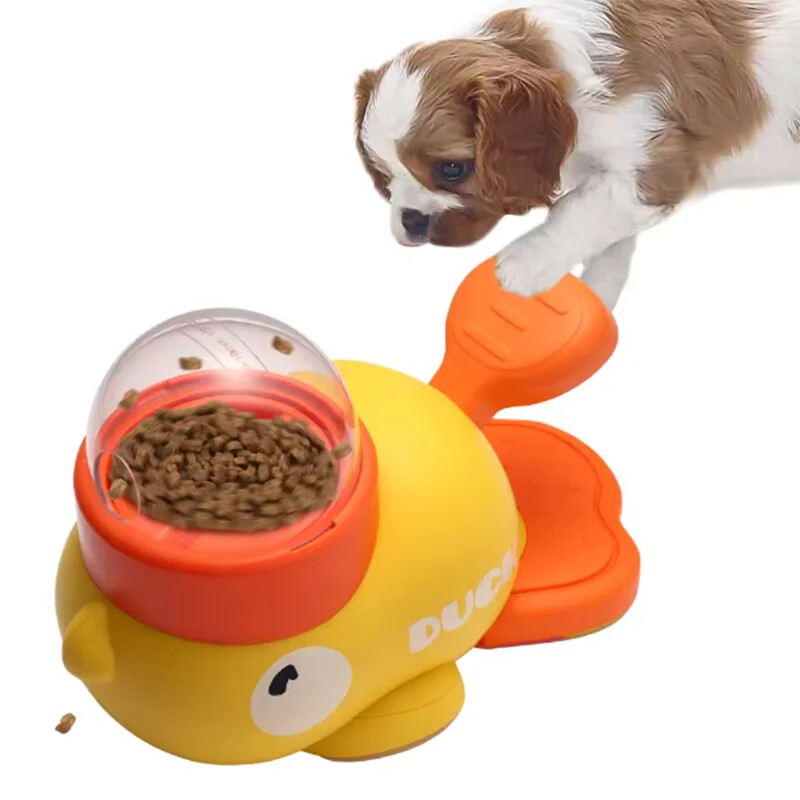
- Paw-operated dispensers. A feeder the dog taps to release a few pieces at a time keeps the meal slow while letting them stand normally throughout. Our own Duckpawl treat dispenser works this way, and it suits dogs who can still use a front paw comfortably but find bowl mazes hard going.
Rotating between two or three of these is usually better than committing to one. Joint pain is not constant, and a setup that suits a good day may be too much on a stiff morning.
How long a senior dog’s meal should take
Somewhere between five and ten minutes is a reasonable target for most dogs. That is slow enough to make a real difference to how the meal settles, and short enough that it does not become an endurance test.
The useful signal is not the clock, though. It is whether your dog finishes. A dog who eats steadily for eight minutes and cleans the bowl has a puzzle pitched about right. A dog who works for three minutes, leaves a third of the food, and wanders off has one pitched too hard, and the honest response is to make it easier rather than to wait them out.
Be careful about reading that as a training problem. With a younger dog, walking away from a difficult bowl often is one. With an arthritic dog, it is far more likely to be a straightforward statement about how much standing still and reaching down they can manage in one go.
When to talk to your vet
Feeding setup is worth getting right, but it is not a substitute for a conversation with someone who can examine your dog.
Please speak to your vet if your dog is losing weight, if their appetite changes noticeably over a short period, if they seem reluctant to lower their head at all, if they cry out or flinch while eating, or if they start dropping food they used to manage. Those are signs worth investigating properly, and some of them have nothing to do with joints. Dental pain in particular can look almost identical to feeding reluctance, and no bowl will fix it.
We are not veterinarians, and nothing here is a diagnosis. What we can say with confidence is that a lot of older dogs get labelled as picky when they are simply uncomfortable, and that the fix is often as ordinary as raising the bowl and putting a mat underneath it.
If you want to go further with keeping an older dog mentally busy without asking much of the body, our guide to dog enrichment and brain games covers low-impact options in more detail. You can find the rest of our writing in the guides section.
Common questions
Is a slow feeder a good idea for a dog with arthritis?
Usually yes, provided it is raised to a comfortable height and the maze is shallow. The goal is to slow eating without asking stiff joints to work harder.
How high should the bowl sit?
Roughly at the dog’s lower chest, so the neck stays level rather than dipping. A stand or a stable box works.
What if my dog gives up partway through a meal?
That is a sign the puzzle is too difficult. Widen the channels, lower the difficulty, or split the meal.
Should I stop using it if my dog seems sore?
Stop and speak to your vet. Reluctance to eat can signal pain that has nothing to do with the bowl.