
Most slow feeder bowls are designed for a muzzle that sticks out. A pug, a French bulldog or a Boston terrier does not have one, and the standard deep-channel maze that works nicely for a spaniel can be close to unusable for them. The fix is not to give up on slow feeding but to change the geometry: wide, shallow channels instead of deep narrow ones, a tilted or slanted dish instead of a flat one, and a bowl shallow enough that your dog is not pressing their face into it to reach the last of the food.
Flat-faced dogs are often exactly the ones who most need to slow down. A short muzzle makes it harder to pick up food cleanly, so many of them scoop and swallow rather than chew, and they take in a lot of air along the way. The result is usually a dog who finishes in twenty seconds and then hiccups, snorts or brings some of it back up.
Why standard slow feeders fail short-snouted dogs
A conventional slow feeder works by burying food between tall ridges. The dog uses the length of their muzzle to reach in, and the tongue does the rest. Take away most of the muzzle and two things go wrong at once.
The first is simple reach. Food sitting at the bottom of a narrow channel is genuinely hard to get at, and a dog who cannot reach it will either give up partway or start shoving the bowl around the floor to tip the food out, which defeats the purpose entirely.
The second is pressure on the face. To get into a deep channel, a flat-faced dog has to push their nose and the soft tissue around it against the bowl. That is uncomfortable, and for breeds already working harder than most to breathe while they eat, it is worth avoiding. Outward Hound’s guide to flat-faced breeds goes into the wider set of adaptations these dogs benefit from.
What to look for instead
- Wide, shallow channels. The bowl should slow your dog by spreading food across a surface, not by burying it. If you cannot easily see the bottom of every groove, it is probably too deep.
- A tilt or slant. Angled dishes bring food toward the dog rather than making them reach down and in. Several bowls are sold specifically for short-snouted breeds on exactly this principle.
- Rounded rather than sharp ridges. Soft tissue around a flat face makes contact with the bowl constantly. Rounded edges make that contact unremarkable instead of unpleasant.
- A stable base. A dog who cannot reach food will push. A bowl that slides rewards pushing, and you end up with kibble across the floor.
Height and tilt matter as much as the maze
Raising the bowl slightly helps most flat-faced dogs, for a different reason than it helps an arthritic dog. Here the point is the angle of the head. A dog eating from the floor has to tip their face downward, which pushes food toward the front of a mouth that is already short on room. Bringing the bowl up a few inches lets them approach it more horizontally.
You do not need to buy a stand to find out whether it helps. Rest the bowl on a stable box for a few meals and watch. If your dog eats more calmly, finishes more of the food, or stops nudging the dish around, the height was doing something.
Getting the pace right without making it harder
If your dog is still finishing too quickly in a shallow bowl, resist the urge to move to a harder maze. There are gentler levers available.
- Change the kibble size. Larger pieces take longer to pick up, especially for a short muzzle.
- Add a little warm water. This slows things down and softens the food, which suits dogs who struggle to chew.
- Split the meal. Two smaller portions twenty minutes apart reduce the amount going down in one sitting, without asking anything more of the dog. The American Kennel Club covers this and other approaches to slowing a fast eater.
- Spread it out. A shallow tray or a large flat plate slows a dog considerably just by making them move along it, with no maze at all.
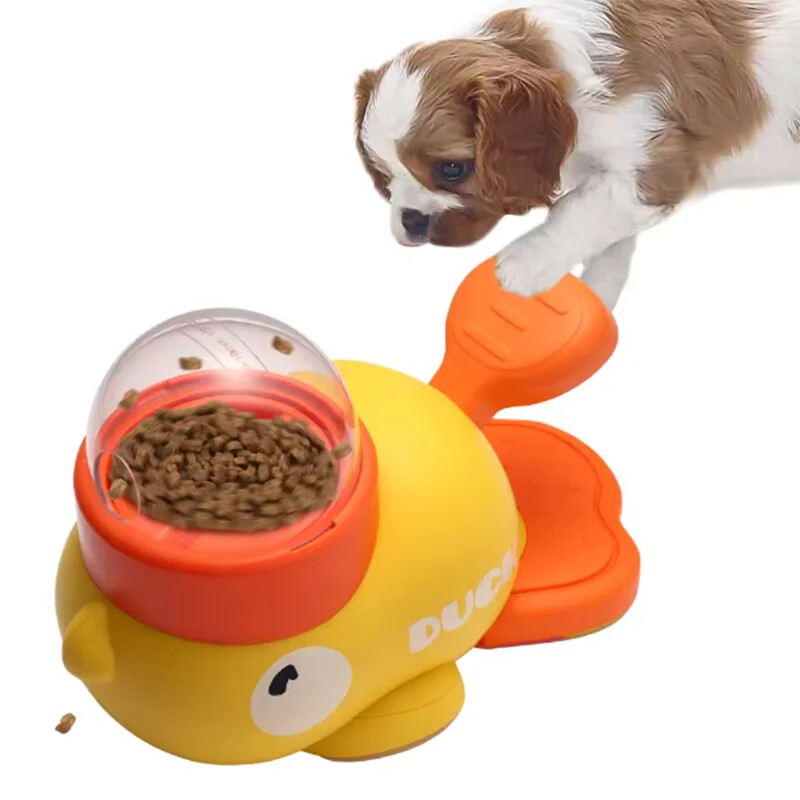
For dogs who take well to using a paw rather than their face, a tap-operated dispenser sidesteps the muzzle problem completely, since the food comes out to them rather than the other way round. Our Duckpawl treat dispenser works this way and suits dogs who find bowl mazes awkward.
Signs the bowl is wrong for your dog
Watch a couple of meals properly rather than judging by the clock. The things worth noticing are:
- Food left in the channels at the end, particularly in the deepest parts.
- Pushing the bowl across the floor rather than eating from it.
- Giving up and walking away with food still there.
- Noisier breathing during the meal than before it.
- Bringing food back up shortly afterward.
Any of those means the setup is asking too much. The correct response is to make it easier, not to wait for your dog to adapt. A slow feeder is meant to add a mild, useful delay, and once it becomes a genuine obstacle you have stopped getting the benefit and started creating a different problem.
Wet food, dry food and the muzzle problem
Food type changes how much the bowl shape matters. Dry kibble has to be picked up piece by piece, which is exactly the action a short muzzle finds awkward, so bowl geometry matters most here. Wet food is scooped with the tongue rather than gripped, so a flat-faced dog often manages it more easily even in a bowl that is otherwise too deep.
That has a practical consequence. If you feed wet food and your dog still finishes in seconds, a maze bowl may do less than you expect, because the tongue simply follows the grooves. Spreading the same portion thinly across a wide flat dish or a lick mat usually slows a wet-food eater far more effectively than ridges do.
For dogs on a mix of both, it is worth judging the bowl on the dry meal rather than the wet one. That is the meal where the design is doing real work.
Cleaning matters more with a flat face
This is the part almost every bowl guide skips, and for these breeds it is genuinely important. A dog with a short muzzle and facial folds ends up with food residue on and around the face after most meals, and a bowl that spreads food across a wide surface increases the contact.
None of that is a reason to avoid a well-shaped bowl, but it does mean building a quick wipe into the routine after meals, particularly for dogs with deep folds. It also means the bowl itself needs proper cleaning rather than a rinse, since shallow wide channels hold a thin film of food that is easy to overlook. Check whether yours is dishwasher safe before assuming it is, because many silicone and coated bowls are not.
What about flat-faced cats?
The same problem applies to Persians, exotics and other short-faced cats, and it is even less well served by the products on the market. Most cat puzzle feeders assume a cat can get their face into a fairly narrow well, which a Persian often cannot do comfortably.
The adaptations are the same in principle: shallow wells rather than deep ones, wide openings, and flat mats in preference to anything requiring the cat to reach inside. If your flat-faced cat has quietly stopped using a feeder they used to tolerate, the difficulty is worth checking before concluding they have simply lost interest.
When to talk to your vet
Some of what looks like a bowl problem is not one. Please speak to your vet if your dog’s breathing sounds laboured during or after meals, if they regularly bring food back up, if they are dropping food they used to manage, or if their appetite changes noticeably.
Short-snouted breeds have a set of anatomical considerations that deserve proper attention, and eating difficulty is sometimes the first place they show up. We are not veterinarians, and nothing here is a diagnosis. What a well-chosen bowl can do is remove the mechanical difficulty so that anything remaining is easier to spot.
If you want to compare bowl styles more broadly first, our guide to slow feeders for senior dogs covers the same shallow-channel principle from a different angle. The rest of our writing lives in the guides section.
Common questions
Can pugs and French bulldogs use normal slow feeder bowls?
Often not comfortably. Deep narrow channels are hard for a short muzzle to reach into, so look for wide shallow grooves or a tilted dish instead.
Are tilted bowls actually better for flat-faced dogs?
For many of them, yes. A slant brings food toward the dog rather than requiring them to reach down and in, which suits a shorter face.
My dog pushes the bowl around instead of eating. Why?
That usually means they cannot reach the food easily. Try a shallower bowl and a non-slip mat before assuming it is a behaviour problem.
Should the bowl be raised?
A few inches often helps, because it lets the dog approach the food more horizontally instead of tipping their face downward. Test with a stable box first.