
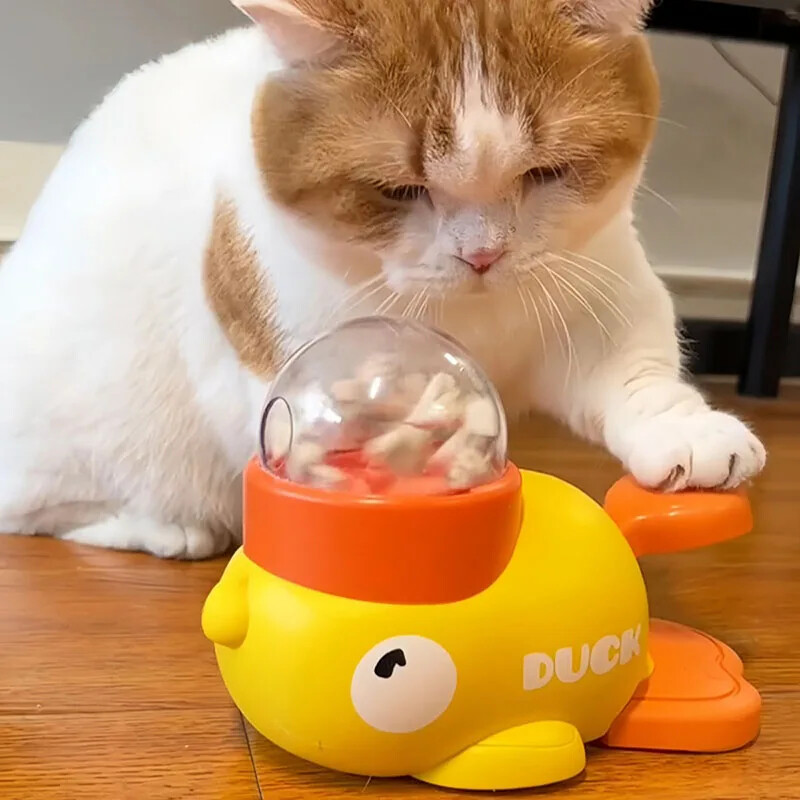
A puzzle feeder is a useful tool for an overweight indoor cat, but it is worth being clear about what it does. It changes how your cat eats, not how much. It slows the meal, adds some movement, and gives an under-occupied cat something to do with the part of the day they would otherwise spend asleep next to a full bowl. What determines whether your cat loses weight is the portion, and no feeder alters that on its own.
That distinction gets blurred in a lot of product marketing, and it matters, because a cat owner who buys a puzzle feeder expecting it to do the work of portion control usually concludes six weeks later that puzzle feeders do not work.
What a puzzle feeder actually changes
Three things, all of them genuine.
It slows eating down. A cat who empties a bowl in ninety seconds and then asks for more is often responding to the speed of the meal rather than the size of it. Spreading the same food over ten minutes gives the cat time to register that they have eaten.
It adds activity. Not much, in absolute terms, but an indoor cat’s baseline is low enough that regular light movement several times a day is not nothing. Batting, pawing and walking between stations all count.
It occupies the mind. This is the underrated one. A lot of indoor cats eat because they are bored rather than hungry, and food that requires attention interrupts that loop. The peer-reviewed review of food puzzles for cats covers the behavioural evidence in detail and is worth reading if you want the underlying research rather than a summary.
The part that matters more
Portion size. If your cat is overweight, the amount of food going into the puzzle is the variable that decides the outcome, and it is a conversation to have with your vet rather than something to estimate from a bag.
The reason this is worth stating plainly is that puzzle feeders make portions harder to judge, not easier. Food disappears gradually, across several devices, sometimes shared with another cat. It is very easy to end up feeding more than you did before simply because the accounting got harder. Measure the day’s total in the morning and portion out from that, rather than filling puzzles as they empty.
If you are new to puzzle feeding altogether, Tufts’ veterinary nutrition service has a straightforward introduction to the different puzzle types and how to pick a first one.
Why indoor cats gain weight in the first place
Worth understanding, because it points at what a feeder can and cannot address. An indoor cat’s day contains very little that has to be worked for. Food arrives in a bowl at a fixed height a few steps from where they sleep. There is no hunting, no searching, and often no competition.
The result is a mismatch between calories in and the effort required to get them. Puzzle feeding reintroduces a small amount of that effort, which is genuinely worth doing, but the gap it closes is modest. Treat it as one part of a plan that also includes measured portions and some active play, rather than the plan itself.
Choosing a puzzle for a heavier cat
Weight changes what is comfortable, and this is where a lot of people pick badly.
- Favour stationary over rolling. Ball-style feeders that have to be chased around a room look like ideal exercise but are hard work for a heavy cat, and many simply opt out. Stationary boards and mats get used more consistently.
- Keep wells shallow. A cat reaching deep into a narrow well is using their shoulder more than you might think. Shallow and wide is easier and still slows them down.
- Watch the height. A heavier cat may not want to stretch up or crouch low. Something at floor level on a flat surface removes the question.
- Start with more openings than you need. Difficulty can always be added later by closing some off.
A tap-operated dispenser is a reasonable option here too, since the movement required is a single paw action repeated rather than sustained effort. Our Duckpawl treat dispenser works for cats as well as dogs on that principle.
Starting without your cat opting out
Cats are less persistent than dogs at anything unrewarding, so the first few sessions decide whether this becomes a habit or an ornament.
Make the first attempt almost too easy. Put food on top of the puzzle rather than inside it, leave every opening wide, and let your cat simply eat from it as though it were a plate. Once they are comfortable approaching the object, begin hiding a little. Introduce it at a normal mealtime when your cat is actually hungry, not as an afternoon novelty.
If your cat ignores it, do not wait them out. Put the regular food down as well and try again the next day at a lower difficulty. There is no benefit to a hungry standoff, and a cat who goes without food for any length of time is a genuine medical concern rather than a training outcome.
Measuring progress honestly
Weigh your cat rather than judging by eye, and do it on the same scales at roughly the same interval. Cats change slowly, and week-to-week variation will tell you nothing useful. Monthly is a more honest cadence.
What you should see early, before any weight change, is behavioural: less bowl-side loitering, less demanding between meals, more time spent on the puzzle. Those come first, and they are a reasonable sign the approach is working even while the scales are static.
Scales are not the only measure worth using. Body condition scoring — feeling for ribs, looking at the waist from above and the tuck from the side — tells you about shape rather than mass, and it often shifts before the number does. Your vet can show you how to do it properly in about a minute, and it is a more useful weekly check than weighing.
Treats are where the plan usually leaks
If you are measuring meals carefully and the weight is not moving, treats are the first place to look. They are easy to forget precisely because they are given casually — a few pieces when you come home, something from the counter, a handful shared between cats.
The useful trick is to stop treating treats as extra. Take them out of the daily measured amount rather than adding them to it, and if you are using a puzzle feeder for enrichment during the day, fill it from that same allowance. This costs you nothing behaviourally, since the cat has no idea whether the food came from the meal or the treat bag, and it closes the gap that quietly undoes a lot of weight plans.
The same applies to anyone else in the household. It is remarkably common for a cat’s weight plan to be undermined by one family member who does not know about it.
Multi-cat households make this harder
If you have more than one cat and only one of them needs to lose weight, puzzle feeding alone will not solve your problem — it may make it worse, since food left in a puzzle is available to whoever gets there first, and the cat who most needs the calories restricted is often the one most motivated to find them.
You need separation as well as puzzles. Feed in different rooms, or at least far enough apart that neither cat is eating over the other’s shoulder. Supervise until you know who is eating what. Some households end up feeding the heavier cat behind a closed door for ten minutes a day, which is unglamorous but works.
Our guide to puzzle feeders in multi-cat households covers the spacing and competition side in more detail.
When to talk to your vet
Before starting a weight plan at all, ideally. A vet can tell you the target weight, the daily amount that gets you there, and whether there is anything else going on — thyroid issues, diabetes and dental pain all affect appetite and weight, and none of them are visible from across a room.
Speak to them promptly if your cat stops eating, loses weight rapidly rather than gradually, drinks noticeably more, or becomes lethargic. Rapid weight loss in cats is not a good outcome even when weight loss was the goal. We are not veterinarians, and nothing here is medical advice.
For getting a reluctant cat started, our guide to puzzle feeding for indoor cats covers the introduction in more depth. The rest is in the guides section.
Common questions
Will a puzzle feeder make my cat lose weight?
Not by itself. It changes how food is eaten, not how much. Portion size is what determines weight, and that is a conversation for your vet.
Are rolling ball feeders good for an overweight cat?
Often not. They demand sustained effort and many heavier cats simply give up. Stationary boards and mats tend to get used far more consistently.
How do I keep track of portions across several puzzles?
Measure the whole day’s food in the morning and fill from that single amount, rather than topping puzzles up as they empty.
My cat ignores the puzzle completely. What now?
Make it easier rather than waiting them out. Food on top instead of inside, every opening wide, offered at a real mealtime when they are hungry.