
A slow feeder makes eating take longer. A puzzle feeder makes eating take thinking. That is the whole distinction, and it is the reason the right answer depends less on which product is better and more on which problem you are actually trying to solve. If your pet inhales dinner and feels rough afterwards, you want a slow feeder. If your pet is bored, restless and looking for trouble by mid-afternoon, you want a puzzle feeder. Plenty of households end up using both, for different moments in the day.
The terms get used loosely, and a lot of products sit somewhere between the two, which does not help. It is worth being clear about what each one is really for before spending anything.
What a slow feeder actually does
A slow feeder is a bowl with obstacles in it. Ridges, mazes, spirals or raised knobs stop your pet taking large mouthfuls, so a meal that took twenty seconds now takes several minutes. There is no problem to solve. The food is visible and reachable the whole time; it just cannot be scooped up all at once.
That simplicity is the strength. A slow feeder works from the first meal, with no learning curve, no supervision, and no risk of your pet giving up in frustration. You fill it and put it down exactly as you would a normal bowl. The American Kennel Club covers why slowing a fast eater is worth doing at all.
What a puzzle feeder actually does
A puzzle feeder hides food behind a mechanism. Your pet has to slide something, lift something, tip something, or work food out through an opening. The food is not simply hard to scoop up; it is genuinely not available until the puzzle is solved.
That difference changes what you get out of it. A puzzle feeder occupies the brain rather than just the mouth, which is why it is the usual recommendation for a pet who is under-stimulated rather than over-fast. It also means there is a difficulty setting, explicitly or otherwise, and pitching it wrong has consequences a slow feeder does not have — a pet who cannot solve the puzzle gets frustrated and gives up.
Which one for which problem
Choose a slow feeder if the issue is pace. Your pet eats too fast, swallows air, gets hiccups, or brings food back up shortly afterwards. You want the meal to take longer without turning it into a project.
Choose a puzzle feeder if the issue is boredom. Your pet is destructive when left alone, restless in the evenings, or living somewhere without much to do. You want their meal to occupy them mentally, not just physically.
Choose both if the two problems coexist, which is common. A slow feeder handles breakfast and dinner reliably. A puzzle feeder handles the middle of the day, or a portion of the daily food set aside specifically for enrichment.
The mistake most people make
The usual error is starting with the hardest puzzle available on the theory that harder is better value. It rarely works out. A pet who fails at a puzzle three times in a row stops trying, and once that association forms it takes a while to undo.
Start easier than you think you need to. If your pet solves it in ninety seconds, that is a good problem to have and you can make it harder. If they walk away, you have learned something less useful and cost yourself some enthusiasm getting there. This applies to cats especially, who are considerably less inclined than dogs to persist at something unrewarding.
Where treat dispensers fit
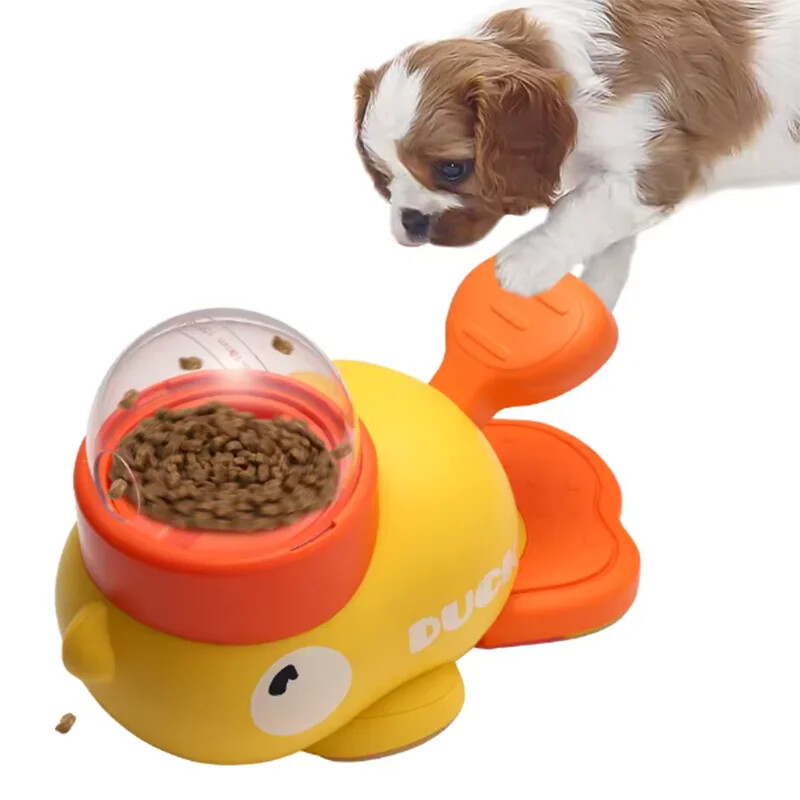
Treat dispensers sit between the two categories and are worth understanding separately. A dispenser releases a small amount of food when the animal does something specific — presses a lever, taps a tail, rolls the toy. Mechanically it is a puzzle. Practically, it is often much gentler than a maze bowl, because the action required is simple and repeatable rather than something to be figured out.
That makes dispensers a reasonable middle option for pets who need slowing down but find bowl mazes physically awkward: older animals, flat-faced dogs, or anyone with sore joints. Our Duckpawl treat dispenser is built on that principle, and works for both dogs and cats.
What neither of them does
Worth being straight about the limits. Neither a slow feeder nor a puzzle feeder reduces how much your pet eats. They change the pace and the effort, not the portion. If weight is the concern, the portion is the thing to address, and the feeder is a supporting measure rather than the intervention.
Neither is a substitute for exercise or company either. A puzzle feeder is a genuinely useful part of a day, not a replacement for the rest of it. And neither one fixes an underlying medical reason for eating strangely — Preventive Vet is worth reading on the range of causes behind a fast eater.
Side by side
Stripped to the essentials:
- Learning curve. Slow feeder: none. Puzzle feeder: real, and it varies by animal.
- Supervision. Slow feeder: none needed. Puzzle feeder: worth watching the first few times, especially with parts that can be moved or chewed.
- Typical meal length. Slow feeder: five to ten minutes. Puzzle feeder: ten to twenty, sometimes longer.
- Failure mode. Slow feeder: your pet eats slightly faster than you hoped. Puzzle feeder: your pet gives up and the food sits there.
- Cleaning. Slow feeder: one piece, usually straightforward. Puzzle feeder: multiple parts, often hand wash only.
- Best for. Slow feeder: pace and digestion. Puzzle feeder: boredom and mental work.
Cats and dogs are not the same case
Most writing on this subject is really about dogs, and cats behave differently enough to matter.
Dogs are generally persistent. Faced with a puzzle they cannot solve, many will keep trying, sometimes destructively. Cats mostly will not. A cat who finds a feeder too difficult tends to walk away and simply not come back to it, which is easy to misread as disinterest in the product rather than a difficulty setting pitched too high.
The practical consequence is that cats need an easier starting point and a more gradual increase. Begin with the puzzle set as open as it goes, or with food sitting on top of it rather than inside, and make it harder only once your cat is using it confidently. International Cat Care has a good walkthrough of that introduction process.
The practical side nobody mentions
Two things decide whether a feeder stays in use after the first fortnight, and neither is performance.
The first is cleaning. A feeder that comes apart into five pieces and needs hand washing will get used less than one you can rinse and refill in ten seconds, regardless of how good it is. Be honest about which you will actually maintain twice a day.
The second is noise. Hard plastic puzzles and dispensers get pushed around floors, and in a flat or an open-plan room that can be genuinely irritating in the evening. A mat underneath fixes most of it, and is worth planning for rather than discovering.
Making the switch without a protest
Pets who have eaten from an open bowl their whole lives sometimes react badly to the change, and a bit of transition avoids that.
For the first few meals, put the usual bowl down alongside the new feeder with part of the portion in each. Your pet gets fed either way, so nothing is at stake, and most animals investigate the new object within a meal or two once it is clearly not a trick. Shift the proportion gradually until the whole meal is in the feeder.
If your pet ignores the feeder entirely, make the first attempt trivially easy rather than waiting them out. Leave the lid off, widen the openings, or put a few pieces on top where they are visible. Success first, difficulty second. That order matters far more than the specific product you chose.
A reasonable starting point
If you are buying your first one and cannot decide, start with a slow feeder. It is cheaper, it works immediately, it needs no supervision, and it establishes the idea that food takes a bit of effort at zero risk of frustration. If your pet takes to that and you find they still have energy to burn, add a puzzle feeder for a portion of the day’s food rather than replacing the bowl entirely.
For more on matching the design to a specific pet, our guides to slow feeders for arthritic dogs and the rest of the guides section go into the physical considerations in more detail.
Common questions
What is the difference between a slow feeder and a puzzle feeder?
A slow feeder makes food harder to scoop up but always visible and reachable. A puzzle feeder hides food behind a mechanism your pet has to work out first.
Which should I buy first?
A slow feeder, usually. It works from the first meal with no learning curve and no risk of frustration, which makes it the safer starting point.
Can I use both?
Yes, and many households do. A slow feeder handles regular meals while a puzzle feeder occupies the middle of the day using food set aside for it.
Will either one help my pet lose weight?
Not on their own. Both change how food is eaten, not how much. Portion size is what determines weight, so speak to your vet about the amount.